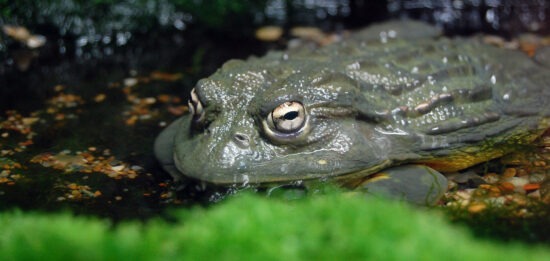
While they are hardy and tolerant of beginner mistakes, truly successful bullfrog keeping moves into a more niche space—one that focuses on understanding their natural cycles, burrowing instincts, and long-term enclosure design. When cared for with intention, African bullfrogs reveal complex behaviors that many keepers never get to see.
Understanding the Burrower, Not the Display Frog
Unlike arboreal or semi-aquatic frogs, African bullfrogs are terrestrial ambush predators. In the wild, they spend much of their lives underground, emerging primarily during seasonal rains. This makes them fundamentally different from frogs that thrive in highly visible, water-heavy setups. A niche but increasingly popular approach is designing enclosures that prioritize deep, compactable substrate rather than open water features.
A substrate depth of 6–10 inches allows natural burrowing and temperature regulation. Coconut fiber mixed with organic topsoil and clay-heavy soil mimics African savanna conditions better than loose, fluffy substrates. When bullfrogs can fully bury themselves, stress behaviors like constant pacing or surface lethargy often disappear.
Seasonal Cycling and Estivation-Inspired Care
One of the most overlooked aspects of African bullfrog husbandry is seasonal cycling. In the wild, these frogs experience dramatic shifts between wet and dry seasons. During droughts, they enter estivation, forming a cocoon-like layer of shed skin to retain moisture underground.
Advanced keepers sometimes replicate mild seasonal changes by slightly reducing humidity and feeding during cooler months, then gradually increasing moisture and food availability to simulate rainy-season conditions. This approach can encourage healthier growth patterns, stronger feeding responses, and more natural behavior rhythms. Full estivation is not required in captivity, but acknowledging the frog’s internal clock can dramatically improve welfare.
Bioactive Enclosures for Heavy Amphibians
Bioactive setups for African bullfrogs are niche but achievable with careful planning. Because these frogs are heavy-bodied and destructive, plant choice matters more than aesthetics. Hardy plants like pothos, snake plant, and certain grasses tolerate occasional uprooting. Clean-up crews should focus on larger, tougher species such as dwarf white isopods and springtails, though spot-cleaning remains essential due to the frog’s waste output.
Drainage layers are especially important in bioactive bullfrog setups. Without proper drainage, deep substrate can become anaerobic and harmful. When done correctly, bioactive systems reduce odor, maintain humidity naturally, and create a more stable microclimate.
Target Feeding and Jaw Power Awareness
African bullfrogs are infamous for their feeding response, but niche keepers quickly learn that how you feed matters as much as what you feed. Tong-feeding is strongly recommended to prevent accidental substrate ingestion and to maintain control around their powerful bite. Adult bullfrogs can exert surprising jaw pressure and should never be hand-fed.
A varied diet of insects (dubia roaches, crickets), earthworms, silversides, and appropriately sized rodents for large adults supports long-term health. Overfeeding is a common mistake; these frogs are built for feast-and-famine cycles, not daily heavy meals.

Long-Term Commitment and Growth Awareness
African bullfrogs are not short-term pets. With proper care, they can live 20 years or more, growing into massive, football-sized amphibians. Many niche keepers plan enclosures with future size in mind from the start, using large tubs or custom-built habitats rather than upgrading repeatedly.
Handling should remain minimal throughout their life. These frogs are display and observation animals, not interactive pets. Respecting their space leads to calmer behavior and fewer stress-related health issues.
Why Niche Bullfrog Keeping Matters
When African bullfrogs are kept with an understanding of their natural history—burrowing, seasonal rhythms, and ambush predation—they transform from “big hungry frogs” into fascinating, prehistoric-feeling animals with depth and presence. Niche care isn’t about making things complicated; it’s about aligning captivity with biology. For keepers willing to go beyond the basics, African bullfrogs offer one of the most rewarding amphibian experiences available.
Sources:
AmphibiaWeb – Pyxicephalus adspersus Species Account
https://amphibiaweb.org/species/5066
Reptifiles – African Bullfrog Care Sheet
https://reptifiles.com/african-bullfrog-care/
National Geographic – African Bullfrog Behavior & Estivation
https://www.nationalgeographic.com/animals/amphibians/facts/african-bullfrog/
Josh’s Frogs – African Bullfrog Care & Feeding
https://www.joshsfrogs.com/catalog/blog/2019/02/african-bullfrog-care-sheet/