

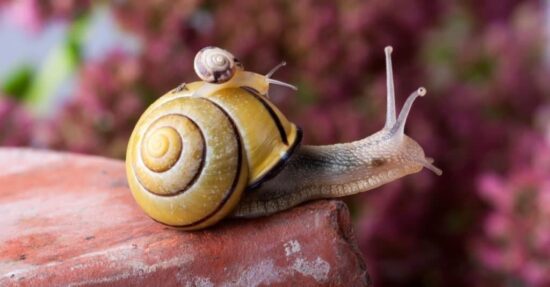
Belonging to the class Gastropoda, snails are soft-bodied mollusks protected by a coiled shell and known for their slow movement, unique anatomy, and vital ecological roles. Though often overlooked, snails play an important part in nutrient cycling, ecosystem balance, and even scientific research.
What Is a Snail?
A snail is a gastropod mollusk characterized by a muscular foot, a soft body, and typically a single, spiraled shell. Snails move by contracting muscles along their foot while secreting mucus, which reduces friction and allows them to travel across rough or vertical surfaces.
Snails can be broadly divided into land snails, freshwater snails, and marine snails, each adapted to very different environments but sharing the same basic body plan.
Anatomy and Unique Features
Snails possess several fascinating adaptations. Their eyes are often located on the tips of retractable tentacles, allowing them to survey their surroundings while staying protected. The shell grows throughout the snail’s life and provides defense against predators, dehydration, and environmental stress.
Most snails breathe using a lung-like structure (land snails) or gills (aquatic snails). They also have a specialized feeding organ called a radula, a ribbon-like structure covered in microscopic teeth used to scrape algae, plants, or organic matter from surfaces.
Habitat and Behavior
Snails are found in nearly every ecosystem except extreme deserts and polar regions. Land snails prefer moist environments such as gardens, forests, and leaf litter, where humidity prevents them from drying out. Aquatic snails live in ponds, rivers, lakes, and oceans, often grazing on algae and biofilm.
Many snails are nocturnal or most active during damp conditions. In dry or cold periods, land snails may enter dormancy by sealing themselves inside their shell with a layer of mucus to conserve moisture.
Diet and Ecological Role
Most snails are herbivores or detritivores, feeding on plants, algae, fungi, and decaying organic material. By breaking down plant matter and recycling nutrients back into the soil or water, snails play a key role in ecosystem health.
Snails are also an important food source for birds, mammals, reptiles, amphibians, and insects. Their presence often indicates a balanced environment, especially in freshwater systems where they help control algae growth.
Snails in Captivity and Education
Some snail species, such as garden snails and freshwater aquarium snails, are commonly kept for educational purposes. They are valued for their low space requirements and ability to demonstrate concepts like growth, reproduction, and environmental sensitivity.
However, responsible care is essential. Snails require appropriate humidity or water quality, calcium sources for shell health, and diets suited to their species. It is also important never to release captive snails into the wild, as non-native species can become invasive.
Are Snails “Simple” Animals?
While snails may appear simple, they are far from insignificant. They have complex behaviors, specialized anatomy, and strong environmental dependencies. Their sensitivity to pollution and habitat change makes them important indicators of environmental health.
Understanding snails encourages a broader appreciation for small, often unnoticed animals that quietly support ecosystems around us.
Sources:
British Malacological Society. (n.d.). Research and education on snails and slugs.
Barker, G. M. (2001). The Biology of Terrestrial Molluscs. CABI Publishing.
Smithsonian National Museum of Natural History. (n.d.). Mollusk and gastropod educational resources.
National Geographic. (n.d.). Articles on snails and mollusks.
University of Florida IFAS Extension. (n.d.). Land and freshwater snail ecology guides.
International Union for Conservation of Nature (IUCN). (n.d.). Mollusk conservation and species assessments.