
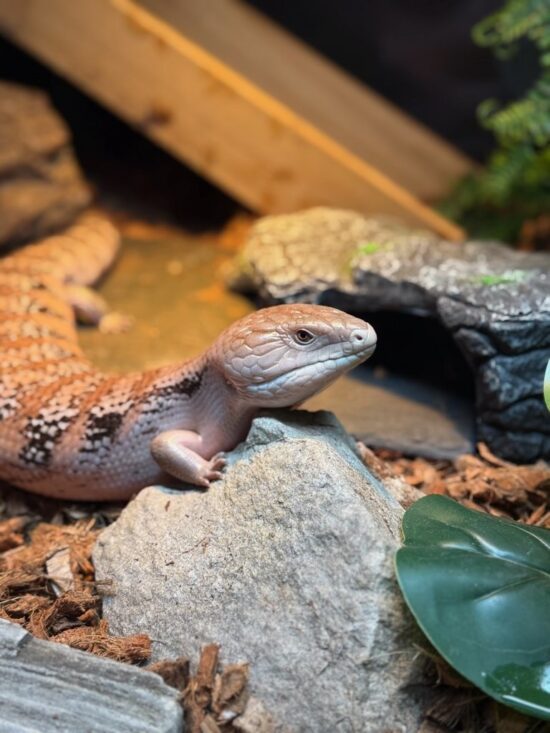
Dietary ratios and feeding frequency should change as the skink matures. Skinks under one year of age should receive a diet consisting of 60–80 percent protein and 20–30 percent vegetables. Skinks over one year of age should be fed a diet of 40–60 percent protein and 40–50 percent vegetables.
Feeding frequency is determined by age:
- skinks three months and younger: fed once daily
- skinks three to eight months old: fed three times weekly
- skinks eight months and older: fed once or twice weekly.
Portion size at each feeding should be approximately equal to the current size of the skink’s head, with food offered flat rather than piled. Foods offered to blue-tongue skinks are divided into two categories: staples and treats. Staples are nutritionally dense foods suitable for regular feeding, while treats are lower in nutritional value and should be fed only occasionally.
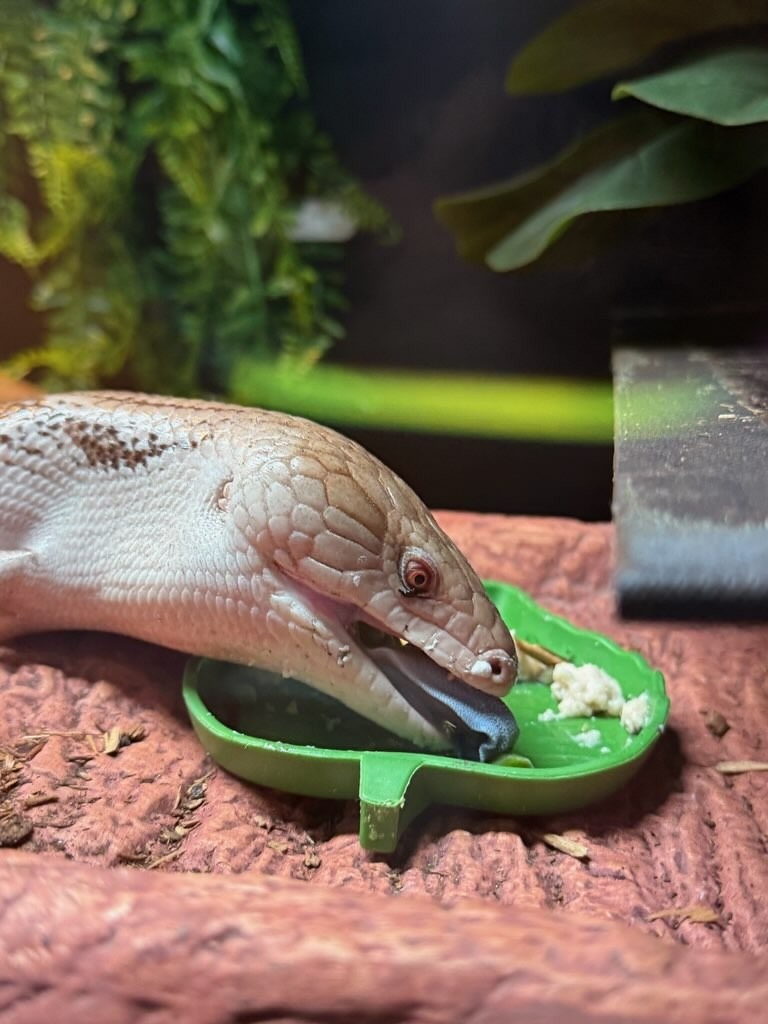
Protein Options:
Staples: include dubia roaches, discoid roaches, crickets, grasshoppers, black soldier fly larvae, locusts, earthworms, and high-quality wet cat or dog food (see below for more information)*
Treats: include snails (raised for human or pet consumption or canned with no additives), silkworms, hornworms, eggs (prepared raw, boiled, or cooked without oils or seasonings), butterworms, mealworms, superworms, cooked chicken meat or hearts (without oils or seasonings), cooked lean beef (without oils or seasonings), and cooked lean turkey (without oils or seasonings)
**Cat/Dog Food for Blue Tongue Skinks: How frequently a blue tongue skink should be fed cat/dog food is a widely debated topic. Many believe it is an essential staple that is necessary to ensure all needed vitamins/minerals are acquired. Some, however, believe that these nutritional values can be met with the combination of other protein options. Please do your own research to determine what you think is best for your blue tongue skink. I personally use dog food as a staple for my skink, Fig. If you choose to use cat/dog foods, here is what you should know:
- Cat food is often used for skinks under the age of one year old due to its higher protein content. After a skink reaches a year old, they are generally switched to dog food.
- Always wet food- no kibble/dry mixes
- Should be grain-free
- Avoid fish/fish oil ingredients
- Contains as many whole animal ingredients as possible- meat, bones, tissues, organs, etc.
- Avoid fillers such as potatoes and rice
- Avoid vegetable ingredients that may be dangerous- onion, rhubarb, avocado, garlic, eggplants, tomato greens
Vegetable/Fruit Options:
Staples: include collard greens, mustard greens, arugula, acorn, spaghetti, and summer squash, dandelion greens, cactus pads/leaves, fresh alfalfa, and green beans.
Treats: include kale, bell peppers, parsnips, peas, asparagus, celery, carrots, Bok choy, pumpkin, mango, papaya, apples, blueberries, bananas, blackberries, strawberries, and figs.
*Fruit should make up no more than 10 percent of the overall diet and should be offered only as an occasional treat.
Supplementation:
Supplementation is generally recommended in the form of a calcium supplement at every feeding and a multivitamin once weekly. Calcium products such as Zoo Med Repti-Calcium or Fluker’s Calcium without D3 should be lightly dusted onto insects or sprinkled over meals. Once weekly, the calcium supplement may be replaced with a multivitamin such as Rep-Cal Herptivite or Repashy Calcium Plus. Repashy Bluey Buffet is another optional product; it is a powdered mix that forms a gel when combined with boiling water and contains a wide variety of beneficial ingredients, making it a useful occasional addition to meals.
Other Important Notes:
- Frozen foods and vegetables must always be fully thawed before feeding, as offering frozen items can potentially send a skink into shock. Frozen foods can be thawed at room temperature or under warm running water.
- Some skinks may be reluctant to eat vegetables; in these cases, vegetables can be finely chopped or blended and mixed thoroughly with wet protein sources such as cat or dog food, cooked meats, canned snails, or Repashy Bluey Buffet.
Written by Hannah Launius