
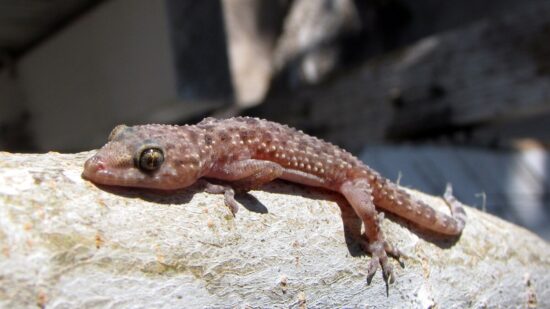
Often spotted on walls near porch lights at night, Mediterranean house geckos are quiet insect hunters that play an important ecological role.
Natural History and Behavior
Mediterranean house geckos are nocturnal and arboreal, spending their nights actively hunting insects attracted to artificial lighting. During the day, they hide in cracks, crevices, tree bark, and buildings to avoid predators and heat.
One of their most notable traits is their adaptability. Unlike many reptiles, they tolerate human activity well and often benefit from it. Their ability to climb smooth surfaces comes from specialized toe pads covered in microscopic structures that allow them to adhere to walls and ceilings with ease.
They are generally shy, fast-moving, and non-aggressive. When threatened, they may drop their tail as a defense mechanism, which can later regenerate.
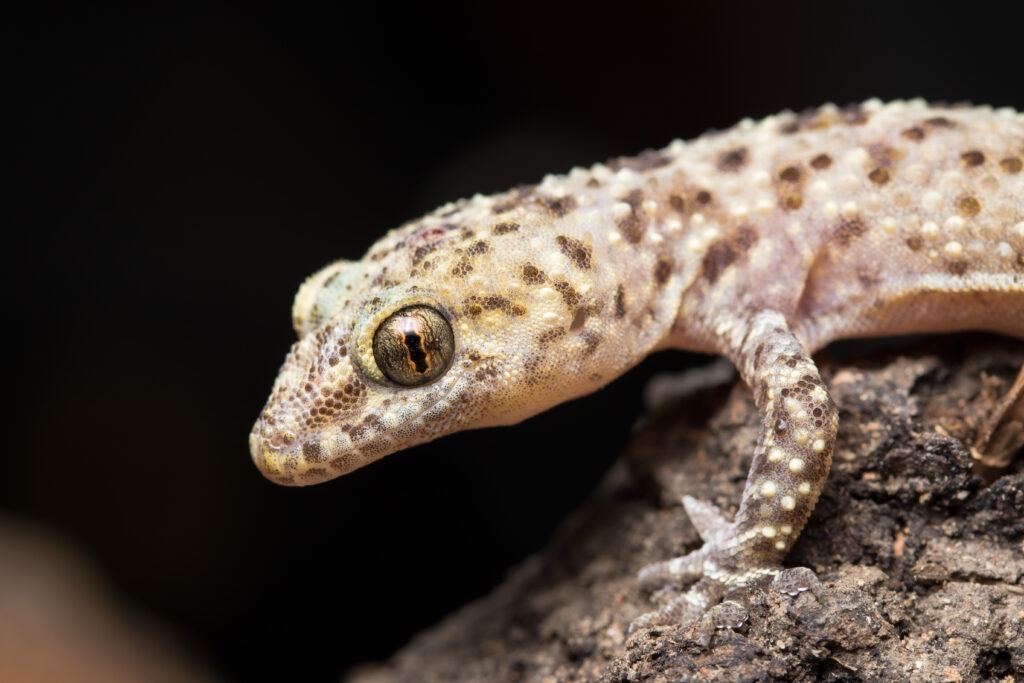
Appearance and Size
Mediterranean house geckos are small and lightly built, typically reaching 4–5 inches in total length, including the tail. Their skin is semi-translucent and ranges from pale pink or gray to light tan, often patterned with darker spots or bands.
Unlike many gecko species, they lack eyelids and instead have clear eye coverings, which they clean using their tongues. Their delicate appearance and expressive eyes make them easy to recognize once you know what to look for.
Habitat and Environmental Needs
In the wild, Mediterranean house geckos inhabit rocky areas, forests, and human structures. They prefer warm climates and are most active in temperatures above 75°F. While they can survive brief cold periods, extended low temperatures are harmful.
In captivity, they require vertical enclosures with plenty of hiding spaces, climbing surfaces, and proper ventilation. Because they are fast and delicate, they are best suited for experienced keepers or those interested in display-style reptiles rather than hands-on pets.
Diet and Feeding
Mediterranean house geckos are insectivores. Their diet consists primarily of small insects such as moths, flies, crickets, and roaches. In the wild, they provide natural pest control by reducing insect populations around homes.
In captivity, prey should be appropriately sized and supplemented with calcium and vitamins. Clean water should be provided in shallow dishes or via light misting, as they often drink droplets from surfaces.
Interaction and Handling
These geckos are not suitable for frequent handling. Their skin is fragile, and they can become stressed easily. Handling attempts often result in escape behaviors or tail loss. For this reason, Mediterranean house geckos are best appreciated through observation rather than interaction.
Their presence alone can be beneficial, especially in outdoor or semi-natural environments where they help control insects without posing any threat to humans.
Are Mediterranean House Geckos Good Pets?
Mediterranean house geckos are fascinating, low-impact reptiles, but they are not traditional pets. They thrive best when their environment mimics natural conditions and when human interference is kept to a minimum.
For those interested in ecology, urban wildlife, or small reptile behavior, they offer a unique opportunity to observe how wildlife adapts to human-altered environments. Responsible care means understanding that coexistence—not ownership—is often the healthiest relationship with this species.
Sources:
British Herpetological Society. (n.d.). Reptile behavior and welfare resources.
Bartlett, R. D., & Bartlett, P. (2012). Geckos: The Animal Answer Guide. Johns Hopkins University Press.
Reptile Database. (n.d.). Hemidactylus turcicus species profile.
International Union for Conservation of Nature (IUCN). (n.d.). Hemidactylus turcicus Red List assessment.
University of Florida IFAS Extension. (n.d.). Mediterranean house gecko overview.
National Geographic. (n.d.). Articles on geckos and urban wildlife.